NBA Players Are Underpaid. They Are Not Undervalued. There Is a Difference.
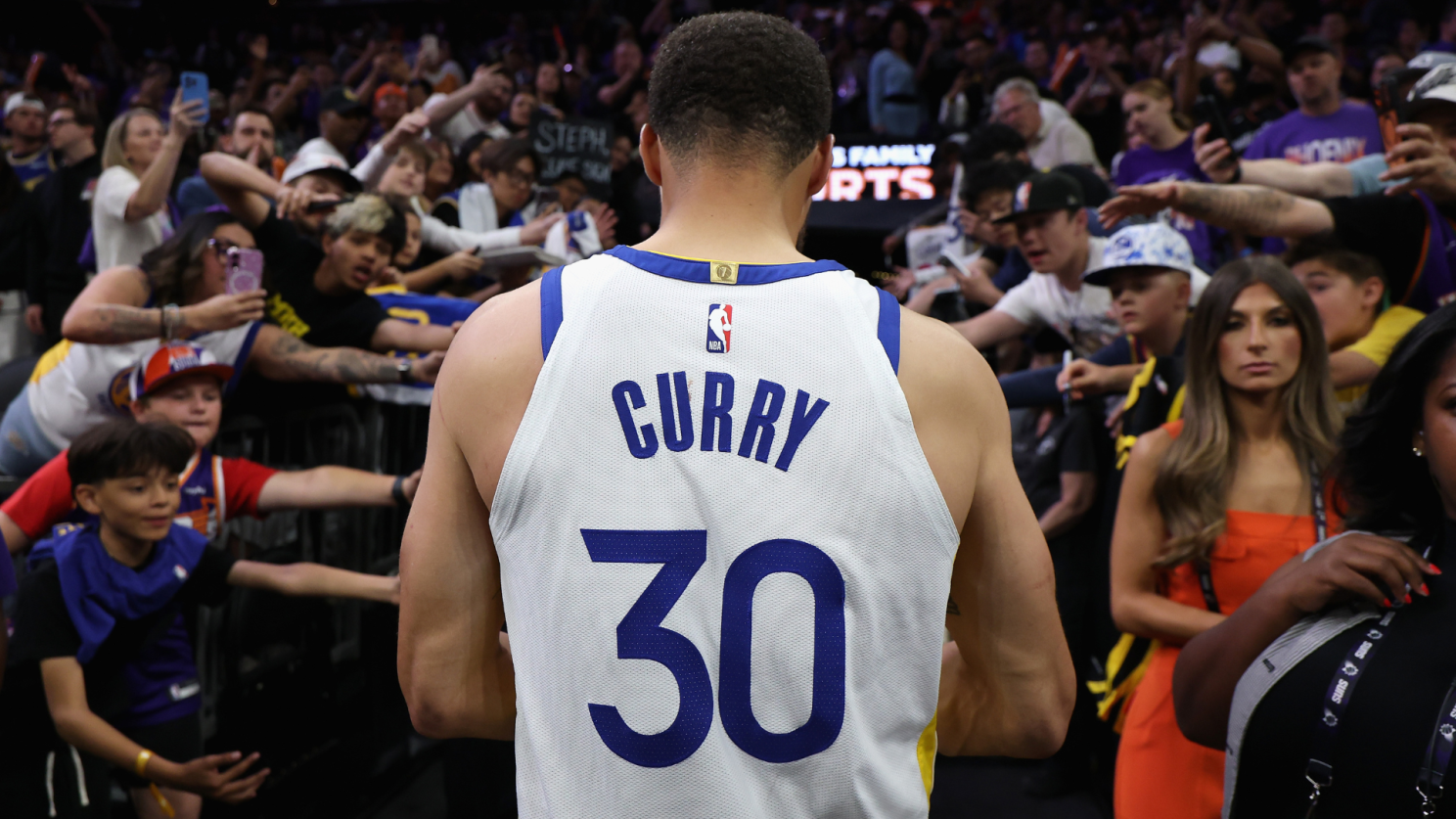
When Steph Curry said NBA players are underpaid, the internet may not have heard what he was saying.
They may have missed his shot, but he didn't.
Curry wasn't talking about himself. He wasn't talking about his $62.6 million salary or his Under Armour empire or his venture portfolio. He used a specific word deliberately — and it's the word everyone glossed over.
"We."
"The idea that we can't participate in equity while we're playing is a part of why I would say yes, we are underpaid. Hopefully sooner than later those rules change so that players can participate more in the upside of team equity. I think we deserve it."
He was talking about the player who suits up for a 4.5-year career and retires with a salary history but no appreciating asset. He was talking about the WNBA player earning $250K at the peak of her career while the league she built an audience for compounds in value around her. He was talking about every player at every level who generates cultural equity that flows upward into ownership structures they are contractually excluded from. It's not personal, it's the structure of business. Business is often seen but not understood. Curry's observation was from the vantage point one part player/laborer and one part owner/investor.
This was not a grievance. It was a signal to the market about what is possible — and a framework that the smartest players have already quietly been executing.
Underpaid Is Not the Same as Undervalued
This distinction matters and language is always the loudest signal the public doesn't hear.
Underpaid is a structural observation about compensation mechanics. It means the form of payment — linear salary, taxed as ordinary income, with no appreciation upside — does not capture the full value being created.
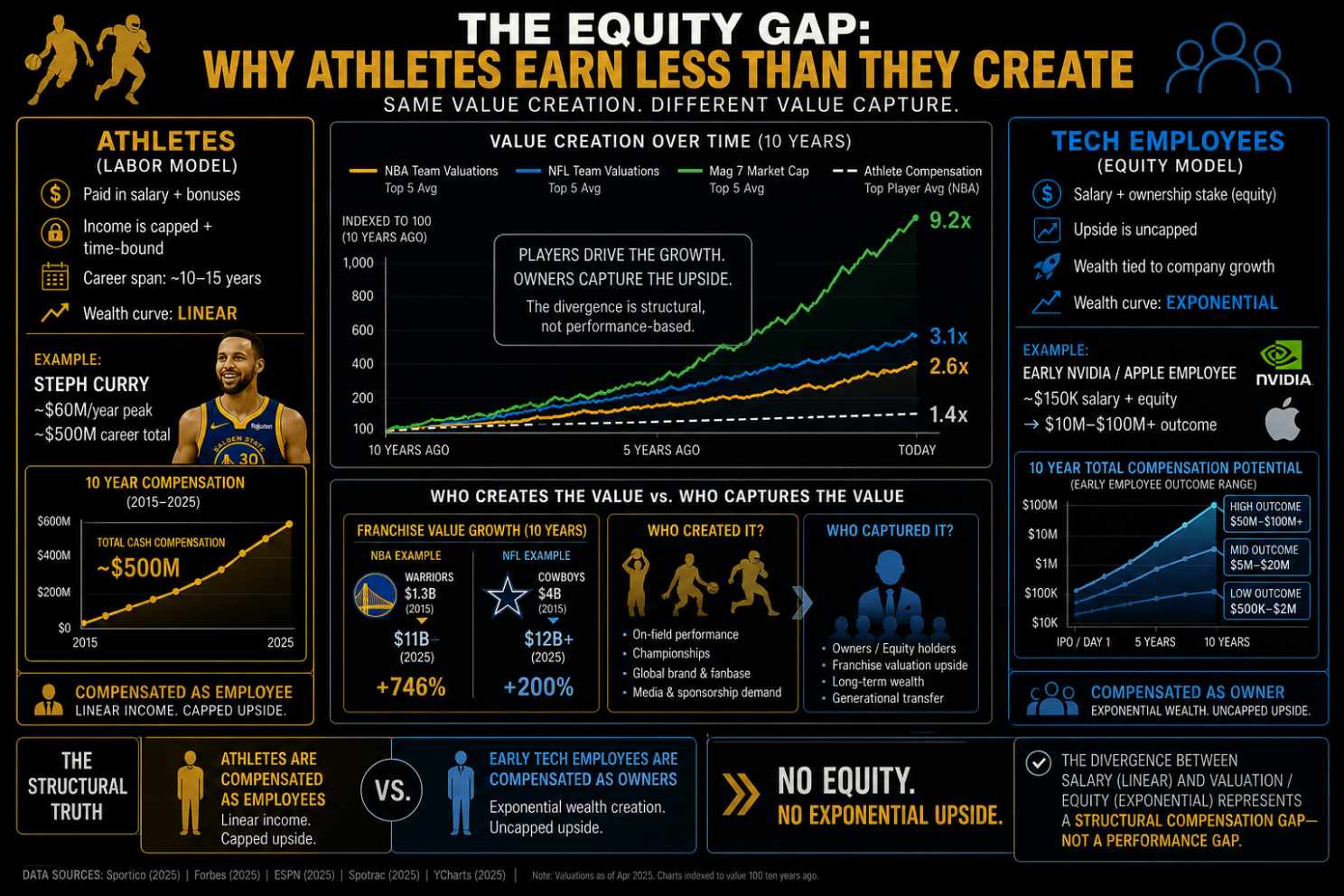
Undervalued is a market observation about recognition. NBA players are not undervalued. The market knows exactly what Steph Curry is worth. The Warriors went from a $450 million franchise to an $11 billion franchise during his tenure. The NBA just signed a $76 billion media deal. The WNBA's valuation has grown over 200% in three years, driven substantially by a generation of players whose cultural reach extends far beyond the sport. My previous notion of Caitlin Clark examines the early signal of her continued crossover of men and women fans. The players are valued. They are compensated linearly for exponential value creation. Often the broader value is found outside of the arena driven by their performance for the global market to value.
That is the gap Curry was pointing at.
Getty
The Tech Company Parallel For Context
Silicon Valley solved this problem decades ago. It is called equity compensation, and the principle is straightforward: if you are going to ask someone to build something that could be worth ten times what it is today, you give them a stake in the upside — not just a salary for their time. In this market it is their time and intellectual capital. In the professional sports market it is their intellectual capital, the leasing of their greatest asset, their body and their time.
The Magnificent 7 — Apple, Nvidia, Microsoft, Meta, Alphabet, Amazon, Tesla — created more millionaires through equity grants to early employees than through any other mechanism. An engineer at Nvidia in 1999 earning $120K in salary and $85K in equity options who held those shares has seen that equity appreciate over 18,000%. Their salary was the cost of living. Their equity was the wealth.
Now apply that lens to sports:
An early Warriors employee — say a player drafted in 2009 — received salary. The owners received equity. The salary was paid annually, taxed at ordinary income rates (up to 50.5% in California), and spent, saved or invested outside of the league. The equity compounded from $450 million to $11 billion, taxed only at capital gains rates upon a sale event.
Same organization. Same value creation. Structurally opposite wealth outcomes.
The NBA's collective bargaining agreement codifies this asymmetry. Active players cannot hold ownership stakes. They are, by rule, participants in the revenue — not stakeholders in the appreciation.
Lebron James founder Springhill Company Merger
What LeBron and Curry Maxed on their own.
Curry's comment was less a complaint and more an observation of his journey as player and businessman, father and husband delivered in public.
LeBron James and Steph Curry are not wealthy because of only their salaries. Their dedication and discipline yielded visible tangible metrics on the court with a finite amount of time night after night like a living breathing public company with incredible agility and style televised nightly. Have you seen a game probability tracker? Looks just like stock chart. These men are wealthy because of how effectively they translated the game and cultural dominance into ownership positions.
Their salaries — while historic — served as only seed capital. Not the endgame.
LeBron converted global influence into equity stakes in sports franchises, a scalable media company in SpringHill Entertainment, and consumer brands. He is a minority owner of the Boston Red Sox parent company Fenway Sports Group. He has expressed intent to own an NBA franchise. His wealth does not live in his playing contracts. It lives in assets that will appreciate well into his legacy.
Curry extended his impact through brand equity with Under Armour — including an equity stake negotiated early in that partnership — venture investments across technology and consumer companies, and media. His portfolio compounds beyond his playing years. The court was the platform. The portfolio is the business.
In both cases, the mechanism is identical to what the best-compensated tech employees have always done: convert visibility, relevance, and early access into ownership of appreciating assets. Shift from participant in the system to stakeholder in its upside.
Their salaries gave them the capital and the credibility to execute their long term strategies.
The WNBA Dimension Curry Included in "We"
This is the part of the conversation that deserves its own spotlight.
The WNBA is in the middle of one of the most significant growth stories in American sports. Attendance records broken. Viewership up over 300% in two years. Caitlin Clark's rookie season generated more economic activity for the Indiana Fever than any player in franchise history. The league's valuation trajectory looks like a pre-Series B startup that just found product-market fit.
The players who built that foundation — A'ja Wilson, Angel Resse, the Diana Taurasis, the Sue Birds, the Breanna Stewarts, — did so during years when WNBA salaries averaged under $100K. They created the cultural infrastructure that is now monetizing rapidly. They are not the primary beneficiaries of the appreciation they generated.
Curry's "we" I believe includes them. The argument about equity participation, about players converting cultural value into ownership, applies with even greater force to athletes whose linear pay was never close to reflecting the value they created. And they fought with the public for it and with them.
The WNBA's moment is precisely the kind of inflection point where equity participation would have transformative generational wealth implications — for players who are currently active, and for the ones who came before them.
What Linear Pay Cannot Do
Salary is a brilliant short-term tool and a poor long-term wealth-building vehicle — especially at high income levels in high-tax states.
A player earning $50 million in California keeps approximately $24.75 million after federal and state taxes. That is real money. But it is a one-time event. It does not compound. It does not appreciate. It does not generate returns while the player sleeps or after their career ends.
Equity does all three.
The after-tax wealth gap between $50M in salary and $50M in equity — held for ten years in an appreciating asset — is not incremental. It is transformational. The equity holder pays capital gains rates (approximately 33% combined in California) only at the point of sale, after years of pre-tax compounding. The salary earner pays ordinary income rates (approximately 50.5%) on every dollar, every year, with no compounding on the gross.
Over a ten-year NBA career, this structural difference means two players who generate identical value for their organizations can end up in vastly different financial positions — not because of what they earned, but because of the form in which they were compensated.
This is the system Curry was describing. Not with bitterness. With precision.
The Signal and What It Points Toward
Curry's comment was a signal, not a complaint. Read it as a market thesis:
The players who will build generational wealth are not the ones who negotiate the largest contracts. They are the ones who understand that salary is the starting point — the credibility, the capital, the platform — and use it to access the same wealth-building mechanisms that tech founders, venture-backed operators, and franchise owners have always had.
The path is not mysterious:
Convert visibility into brand equity with ownership stakes, not endorsement fees
Invest early in companies and categories where your cultural reach provides an edge
Build media and content assets that generate recurring revenue independent of your playing career
Advocate — through the union, through the CBA, through public discourse — for the structural right to participate in franchise and league equity while active
LeBron and Curry did not stumble into their post-court wealth. They executed a deliberate strategy of converting linear pay into ownership positions — the same move that every successful tech employee, startup founder, and early investor has made.
The difference is that in Silicon Valley, the infrastructure for this conversion is built into the compensation package from day one. In the NBA, players have had to build it themselves, outside the system, after the fact and now for some, while the shot clock runs on repeat.
Curry's "we" was a call to change that. To make the infrastructure available to every player — not just the ones who had the resources, the advisors, and the business sophistication to build it independently.
See content credentials
Generated Visual for article only.
The Thesis: NBA players are underpaid. They are not undervalued.
The market conditions often constrained locally and proximity is worth noting but cannot oversimplify the points. But while the observation is astute, volume of players, exposure, venues and ancillary models of economic are built for the athlete` to indeed perform at a high-level. The compensation structure simply does not deliver that value in the form that builds wealth — equity, appreciation, compounding, ownership.
LeBron James and Steph Curry's wealth is not defined by what they earned on the court. It is defined by how effectively they converted cultural dominance into ownership positions across media, brands, and capital markets. Their contracts were launch capital. Their portfolios are the business.
The players who come after them — in the NBA, in the WNBA, across every league where athletes generate value that flows upward into ownership structures they are excluded from — are worthy of access to the same conversion mechanism inkin with the structure of the stock market in some future form.
Not as a favor. Not as charity.
As calculated investment. Consistent with how every other industry compensates its most productive contributors.
Curry said it, the people debated it.
The data, the history, and the example of every wealth-building athlete of the modern era point to a truth worth a conversation.
What does the future of athlete compensation look like when equity participation becomes a part of the conversation? And which leagues get there first?
Sources: Complex "360 With Speedy" — Stephen Curry interview (2025) | Forbes NBA & WNBA Franchise Valuations 2025 | CNBC Official NBA Valuations | Spotrac Salary Data 2025-26 | Motley Fool Magnificent 7 Returns | SpringHill Entertainment / Fenway Sports Group public filings | California FTB income tax schedules | NBA CBA 2023 active player ownership restrictions